
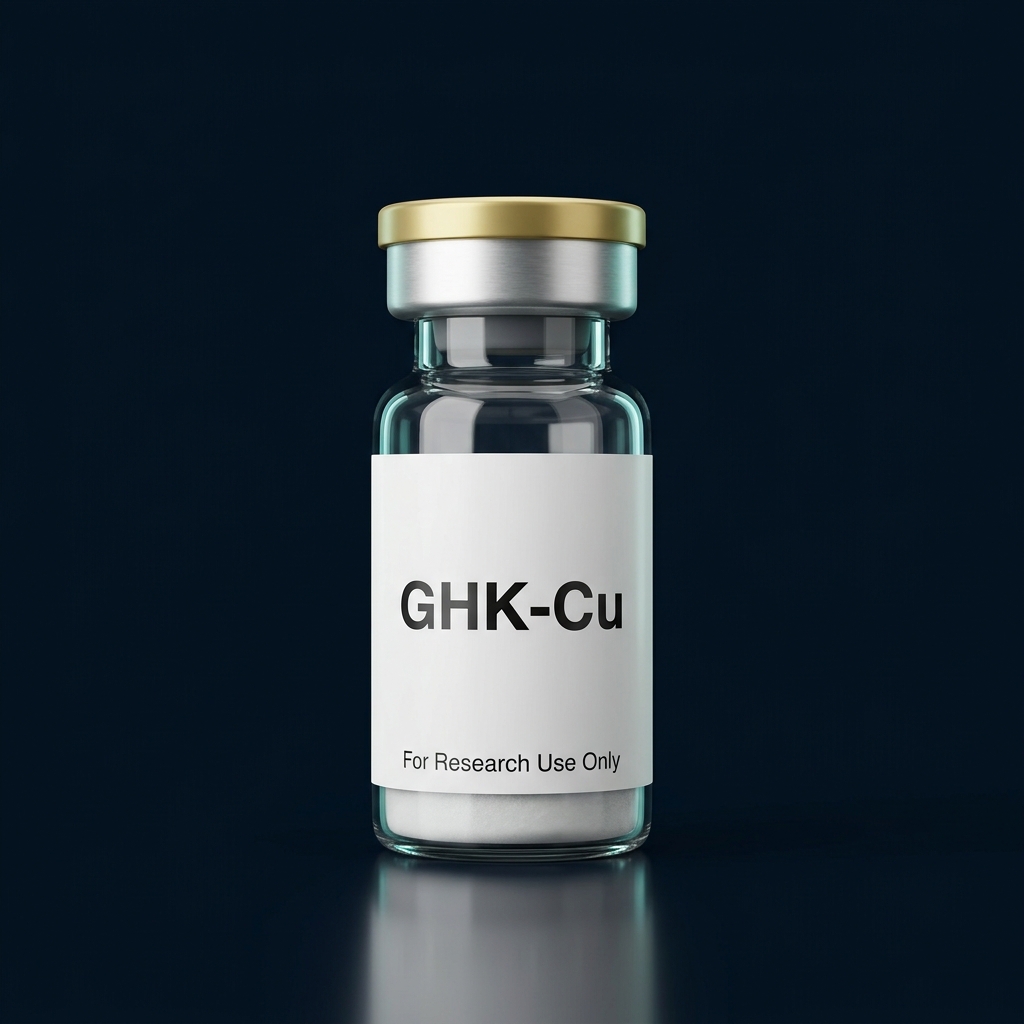
GHK-Cu
Price range: 39.99 € through 69.99 €
GHK-Cu is the copper(II) complex of the naturally occurring Gly-His-Lys tripeptide, studied in gene-expression, fibroblast, extracellular-matrix, and copper-signaling research. Supplied as lyophilized material to a ≥98% supplier batch purity specification, with selected lots independently tested. For laboratory research use only.
| Quantity | Discount | Price |
|---|---|---|
| 3, 4 | 5% off | 37.99 € |
| 5, 9 | 10% off | 35.99 € |
| 10+ Best value | 15% off | 33.99 € |
GHK-Cu – Gly-His-Lys Copper Research Peptide
Introduction to GHK-Cu
GHK-Cu is the copper(II) complex of Gly-His-Lys, a naturally occurring tripeptide first identified in human plasma during research by Loren Pickart in the 1970s. The compound has subsequently become an extensively investigated model for studying copper-dependent signaling, extracellular-matrix biology, fibroblast activity, and gene-expression responses.
The histidine residue within Gly-His-Lys plays an important role in copper coordination. Formation of the copper complex is biologically significant because copper participates in numerous enzymatic and cellular processes. Research involving this tripeptide therefore extends beyond the behavior of the uncomplexed GHK sequence.
The documented product specifications include CAS 49557-75-7, a molecular weight of 403.9 Da, lyophilized format, and a ≥98% supplier batch purity specification.
GHK-Cu Research Overview
Research on this copper peptide spans several decades and includes cell culture, biochemical, gene-expression, and preclinical models.
One major research area concerns extracellular-matrix regulation. Experimental studies have examined fibroblast responses and matrix components including collagen, elastin, decorin, and glycosaminoglycans. Copper-dependent processes and cellular signaling may contribute to these observations.
Angiogenesis-associated signaling has also been investigated, including pathways involving vascular endothelial growth factor (VEGF). Other experimental work has explored TGF-beta-associated signaling, antioxidant enzyme activity, and cellular responses associated with tissue remodeling.
These findings describe experimental mechanisms and should not be interpreted as evidence of cosmetic rejuvenation, wound treatment, anti-aging effects, or other clinical outcomes in humans.
Gene Expression Research
Gene-expression studies have provided another important area of investigation. Connectivity Map-based analyses have reported that GHK exposure is associated with changes in the expression of large numbers of genes across experimental datasets.
One published analysis discussed changes involving thousands of genes and investigated whether these transcriptional patterns could help explain the peptide’s broad activity observed in experimental systems. Researchers can review the supplied gene-expression study for the methodology and interpretation of these findings.
It is more accurate to describe these results as gene-expression modulation than to state that the peptide universally “resets” thousands of genes to a healthy state. Database-derived transcriptional associations depend on the model, experimental conditions, analytical methodology, and interpretation.
Extracellular Matrix and Cellular Research
Experimental literature has investigated effects involving collagen-associated biology, antioxidant enzymes, vascular signaling, and tissue-remodeling pathways. The supplied Life Sciences research article provides additional scientific context for this area.
A broader International Journal of Molecular Sciences review discusses the copper complex in relation to extracellular-matrix components, cellular signaling, gene expression, and other experimental pathways.
Researchers should distinguish mechanistic or preclinical findings from demonstrated clinical effects. Published laboratory observations do not establish that the same responses occur in humans.
Researchers can review the corresponding Certa Peptides GHK-Cu research product and the originally supplied GHK-Cu product reference for product-specific context.
For comparative copper-peptide research, AHK-Cu 100mg provides a distinct Ala-His-Lys copper complex. AHK-Cu and GHK-Cu differ in peptide sequence and should not be treated as interchangeable research compounds.
Researchers exploring mechanistically separate mitochondrial peptide systems can also review MOTS-c. This material is provided as a related research-category reference rather than as a functional equivalent.
General chemical and compound-reference information may be explored through PubChem. External databases do not independently verify the quality or analytical characteristics of a particular Certa Peptides batch.
Quality & Testing
Certa Peptides supplies the material as lyophilized powder to a documented ≥98% supplier batch purity specification. Selected lots are independently analyzed by Janoshik Analytical.
A supplied third-party report for a 50mg lot includes HPLC purity testing and analysis for lead, mercury, arsenic, and cadmium. Researchers can review Janoshik Analytical Report #136727 directly.
Because third-party results apply to the material represented by the tested sample, results from one report should not automatically be interpreted as analytical confirmation for every vial or production lot.
Where available, researchers should use batch-specific analytical documentation when evaluating material for a particular experiment. Selected-lot reports may also be searched using the supplied Certa Peptides batch verification resource.
Storage & Handling
No product-specific storage conditions were supplied in the provided specifications. Researchers should therefore follow the product label, batch documentation, validated laboratory procedures, and institutional requirements for storage and handling.
Copper-containing research materials may also require experimental controls appropriate to the assay being performed. Researchers should consider factors such as light exposure, solvent compatibility, assay conditions, and metal-sensitive experimental systems according to validated laboratory procedures.
No human reconstitution, dosage, injection, administration, topical application, cosmetic-use, supplementation, or treatment instructions are provided.
Frequently Asked Questions
What is GHK-Cu?
GHK-Cu is a copper(II)-binding complex formed by the tripeptide Gly-His-Lys. It occurs naturally in biological systems and has been investigated in copper signaling, fibroblast, extracellular-matrix, and gene-expression research.
What is the difference between GHK and its copper complex?
GHK refers to the Gly-His-Lys peptide itself. Its copper complex forms when the peptide coordinates Cu(II). Copper binding can alter the molecule’s chemical and biological behavior, so experimental observations involving the complex should not automatically be attributed to uncomplexed GHK.
What areas of research involve this copper peptide?
Laboratory literature includes research involving fibroblasts, collagen-associated biology, extracellular-matrix components, antioxidant pathways, vascular signaling, and gene expression. These are experimental research contexts rather than established human benefits.
Does research show that GHK changes thousands of genes?
Connectivity Map analyses have associated GHK with transcriptional changes involving thousands of genes. These findings indicate broad gene-expression associations under specific experimental and analytical conditions; they do not mean that the compound universally resets thousands of genes or produces predetermined clinical outcomes.
What are the documented product specifications?
The supplied specifications identify CAS 49557-75-7, molecular weight 403.9 Da, lyophilized powder format, and a ≥98% supplier batch purity specification. Selected lots have undergone independent analytical testing.
Is GHK-Cu intended for cosmetic or human use?
No. Certa Peptides supplies this compound strictly for laboratory research. References to collagen, fibroblasts, extracellular-matrix remodeling, gene expression, or vascular signaling describe research endpoints and are not cosmetic, medical, or therapeutic claims.
Research Use Disclaimer
Research described on this page concerns laboratory and preclinical models. Findings involving gene expression, fibroblasts, collagen, extracellular-matrix remodeling, antioxidant pathways, TGF-beta, VEGF, or vascular biology should not be interpreted as established regenerative, cosmetic, anti-aging, wound-healing, or therapeutic outcomes in humans.
For laboratory research use only. Not for human or veterinary use. Not intended for consumption or for diagnosing, treating, curing, or preventing any disease.
Laboratory Research Use Only.
| Size |
50mg ,100mg |
|---|
You must be logged in to post a review.
Related products
Epitalon
Price range: 45.99 € through 149.99 €
MOTS-c
Price range: 41.99 € through 103.49 €
Reviews
There are no reviews yet.