
Epitalon
Price range: 45.99 € through 149.99 €
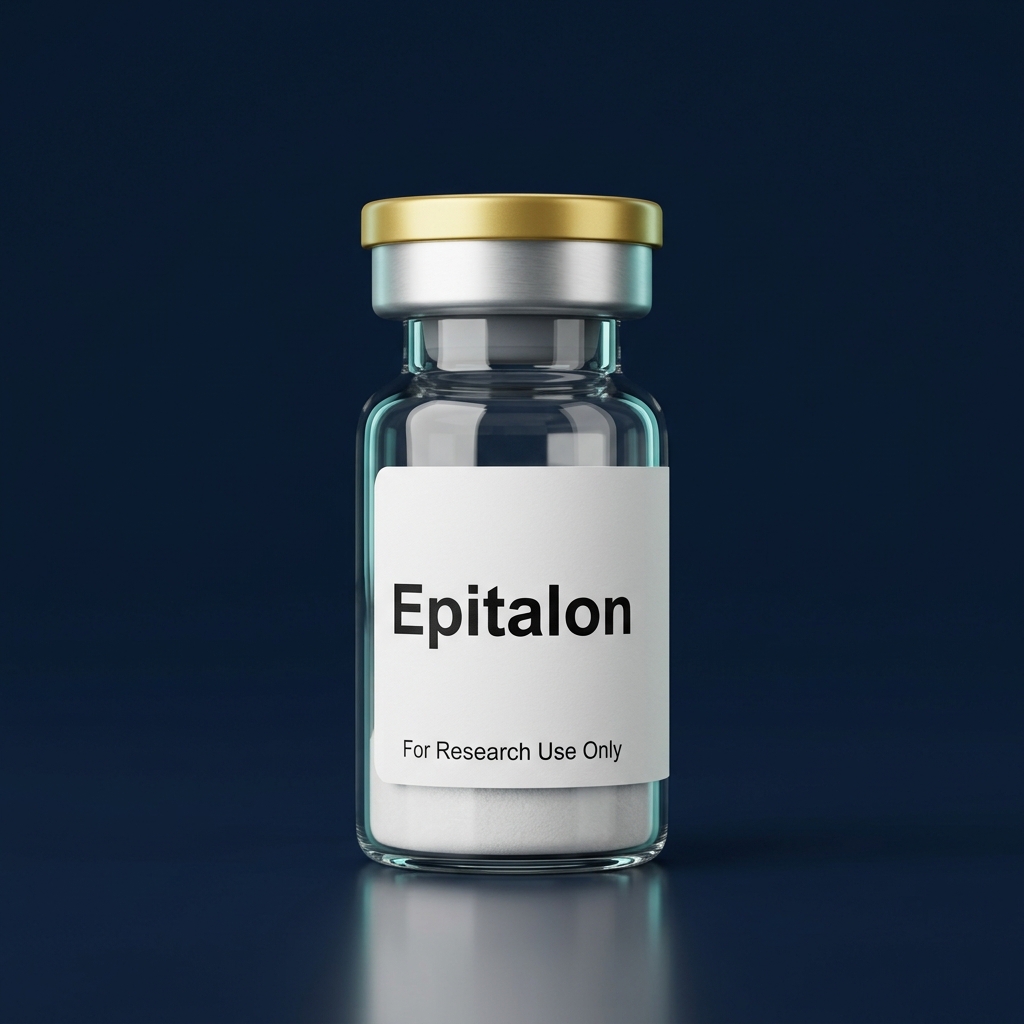
Epitalon (Epithalon) is the synthetic tetrapeptide Ala-Glu-Asp-Gly (AEDG), investigated in laboratory and preclinical models involving telomerase, telomere biology, pineal signaling, and neuroendocrine regulation. Supplied as lyophilized material to a ≥98% supplier batch purity specification, with selected lots independently tested. For laboratory research use only.
| Quantity | Discount | Price |
|---|---|---|
| 3, 4 | 5% off | 43.69 € |
| 5, 9 | 10% off | 41.39 € |
| 10+ Best value | 15% off | 39.09 € |
Epitalon – AEDG Tetrapeptide Research Compound
Introduction to Epitalon
Epitalon, also known as Epithalon, is a synthetic tetrapeptide with the amino-acid sequence Ala-Glu-Asp-Gly (AEDG). It was developed from research associated with epithalamin, a peptide-containing extract derived from pineal tissue, and has subsequently been investigated in laboratory and preclinical models involving telomere biology, cellular aging, neuroendocrine signaling, and pineal function.
The compound is chemically defined by CAS 307297-39-8 and has a documented molecular weight of approximately 390.3 Da. Certa Peptides supplies it as lyophilized research material to a ≥98% supplier batch purity specification.
Published findings discussed here concern cell culture, animal models, and other experimental systems. They should not be interpreted as evidence of anti-aging, sleep, longevity, or therapeutic effects in humans.
Epitalon Research Overview
One of the most prominent areas of investigation involves telomere biology. Telomeres are repetitive DNA-protein structures located at chromosome ends. Progressive shortening can occur during repeated somatic cell division, while telomerase provides one biological mechanism capable of extending telomeric DNA in certain cell types.
Experimental studies have examined whether AEDG exposure influences telomerase-associated pathways in cultured cells.
A published study involving human fetal fibroblast cultures reported changes in telomerase gene expression and enzymatic activity alongside telomere-related observations. Researchers can review the supplied telomerase research publication for the specific methodology, experimental conditions, and findings.
These cell-culture results should not be generalized into claims that the compound reverses human aging, extends human lifespan, or restores telomeres in people.
Pineal and Neuroendocrine Research
The pineal gland provides another major experimental context. Its best-characterized endocrine output, melatonin, participates in circadian signaling and exhibits rhythmic secretion across the light-dark cycle.
Age-associated changes in melatonin rhythms have led researchers to investigate pineal regulatory mechanisms in animal models. A study involving aged rhesus monkeys examined neuroendocrine and metabolic measurements following experimental exposure to AEDG. Researchers can review the supplied Experimental Gerontology publication for the reported observations.
Such findings are useful for hypothesis generation but do not establish that the compound restores circadian function, improves sleep, or produces metabolic benefits in humans.
A more recent International Journal of Molecular Sciences review discusses published research involving telomere-associated, neuroendocrine, antioxidant, neurotrophic, and other experimental pathways. Review-level evidence should be interpreted in light of the underlying study designs and the distinction between preclinical and clinical evidence.
Epitalon and Pinealon
AEDG is related in research history to Pinealon, but the compounds are chemically distinct. Pinealon consists of the three-amino-acid sequence Glu-Asp-Arg (EDR), whereas AEDG contains four amino acids: Ala-Glu-Asp-Gly.
The two peptides therefore should not be treated as interchangeable laboratory materials. Researchers interested in direct comparison can review the Certa Peptides Pinealon research peptide.
The corresponding Certa Peptides Epitalon research product provides product-specific information, while the originally supplied Epitalon 50mg reference provides additional related product context.
Researchers examining oxidative and redox biology alongside peptide models may also review Glutathione 1500mg as a mechanistically distinct research material. It should not be considered functionally equivalent to AEDG.
General chemical and biochemical reference information may be explored through PubChem. External databases provide general scientific reference information and do not independently verify the purity, identity, or quality of a specific Certa Peptides batch.
Quality & Testing
Certa Peptides supplies Epitalon as lyophilized AEDG material with a documented ≥98% supplier batch purity specification.
Selected lots are independently analyzed by Janoshik Analytical. Where available, independent analytical reports can be searched by batch code using the supplied Certa Peptides batch verification resource.
Testing of selected lots should not be interpreted as confirmation that every vial or batch has identical analytical results. Researchers should consult documentation corresponding to the specific batch being used.
The supplied specifications identify the compound as Ala-Glu-Asp-Gly, CAS 307297-39-8, with a molecular weight of approximately 390.3 Da.
Storage & Handling
No product-specific storage conditions were supplied in the provided information. Researchers should therefore follow the product label, available batch documentation, validated experimental protocols, and institutional laboratory procedures for storage and handling.
Experimental design should also account for peptide stability, assay conditions, controls, and the specific model being investigated.
No human reconstitution, dosage, injection, oral administration, supplementation, sleep-use, anti-aging protocol, or treatment instructions are provided.
Frequently Asked Questions
What is Epitalon?
Epitalon is a synthetic four-amino-acid peptide with the sequence Ala-Glu-Asp-Gly (AEDG). It has been investigated in laboratory and preclinical research involving telomere biology, telomerase-associated pathways, pineal signaling, and neuroendocrine regulation.
Are Epitalon and Epithalon the same compound?
Epitalon and Epithalon are commonly used as alternate transliterations for the AEDG tetrapeptide in the research literature. Researchers should still verify sequence, identity, and analytical documentation when comparing materials from different sources.
Why is Epitalon studied in telomere research?
Published cell-culture research has examined telomerase gene expression, enzymatic activity, and telomere-associated responses following experimental AEDG exposure. These observations provide a basis for mechanistic research but do not establish anti-aging or longevity effects in humans.
How does Epitalon differ from Pinealon?
Epitalon is Ala-Glu-Asp-Gly (AEDG), whereas Pinealon is Glu-Asp-Arg (EDR). They are distinct peptide sequences with overlapping but different research histories and should not be treated as interchangeable compounds.
What are the documented product specifications?
The material is supplied as lyophilized AEDG with CAS 307297-39-8, molecular weight approximately 390.3 Da, and a ≥98% supplier batch purity specification. Selected lots undergo independent analytical testing.
Is Epitalon intended for anti-aging, sleep, or human use?
No. References to telomeres, melatonin, circadian biology, or age-associated experimental models describe research contexts only. Certa Peptides supplies the compound strictly for laboratory research and not for personal, cosmetic, veterinary, or therapeutic use.
Research Use Disclaimer
Research described on this page concerns laboratory and preclinical models. Findings involving telomerase, telomeres, pineal biology, melatonin, circadian signaling, antioxidant pathways, neuroendocrine regulation, or cellular aging should not be interpreted as established longevity, anti-aging, sleep, metabolic, or therapeutic outcomes in humans.
For laboratory research use only. Not for human or veterinary use. Not intended for consumption or for diagnosing, treating, curing, or preventing any disease.
Laboratory Research Use Only.
| Size |
10mg ,40mg ,50mg |
|---|
You must be logged in to post a review.
Related products
GHK-Cu
Price range: 39.99 € through 69.99 €
MOTS-c
Price range: 41.99 € through 103.49 €
Reviews
There are no reviews yet.