
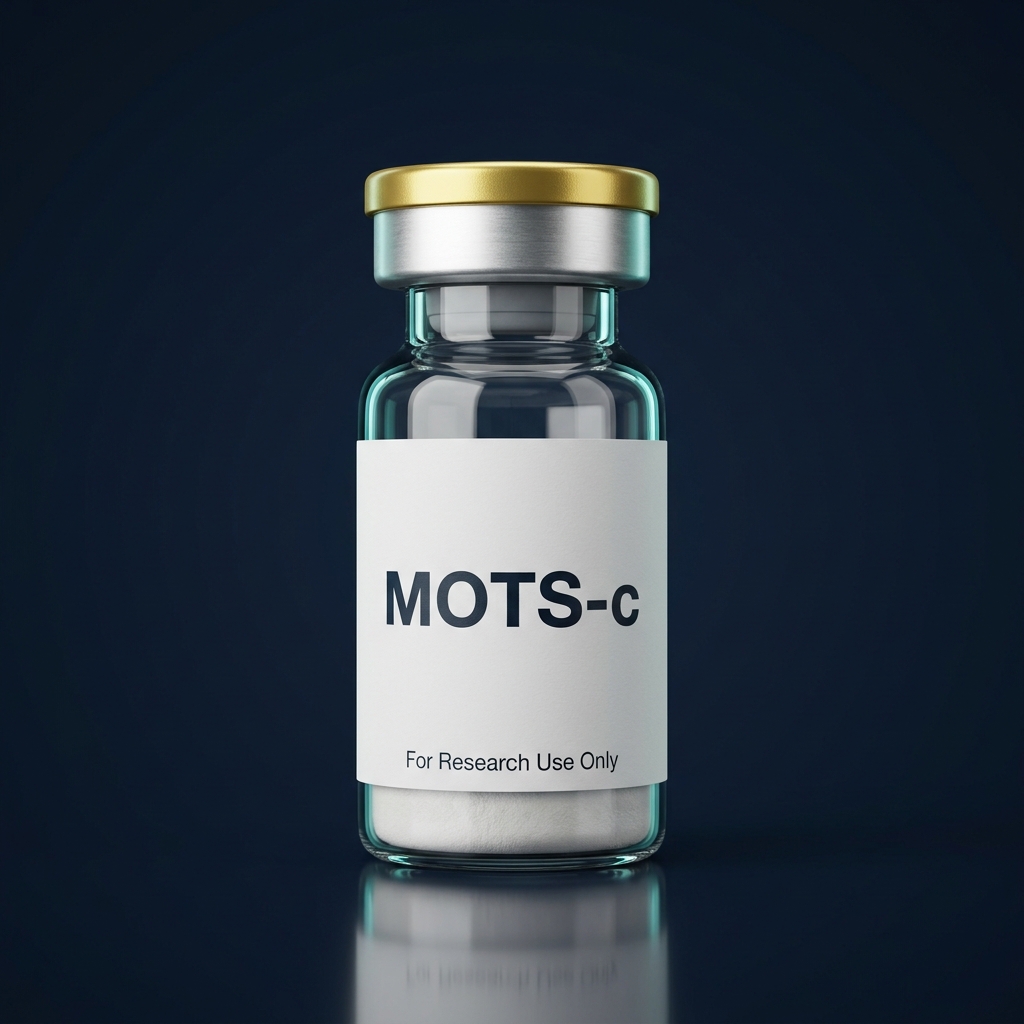

MOTS-c
Price range: 41.99 € through 103.49 €
MOTS-c peptide refers to MOTS-c, a 16-amino-acid mitochondrial-derived peptide studied in AMPK signaling, metabolic stress responses, and mitochondria-to-nucleus communication. Supplied as lyophilized material to a ≥98% supplier batch purity specification, with selected lots independently tested. For laboratory research use only.
| Quantity | Discount | Price |
|---|---|---|
| 3, 4 | 5% off | 39.89 € |
| 5, 9 | 10% off | 37.79 € |
| 10+ Best value | 15% off | 35.69 € |
MOTS-c Peptide (MOTS-c) – Mitochondrial Research Peptide
Introduction to MOT-c Peptide
MOTS-c peptide is a search variant commonly used for MOTS-c, a 16-amino-acid mitochondrial-derived peptide investigated in metabolic signaling and mitochondria-to-nucleus communication. MOTS-c peptide was reported in 2015 as a peptide encoded within the mitochondrial 12S rRNA region, expanding research into the signaling functions of mitochondrial-derived peptides.
Rather than viewing mitochondria solely as sites of cellular energy production, this field examines how mitochondrial signals can influence nuclear gene expression and broader cellular adaptation.
The supplied specifications identify CAS 1627580-64-6, molecular weight approximately 2,174.6 Da, and SKU CP-MOT. Certa Peptides supplies the material as lyophilized powder to a ≥98% supplier batch specification.
MOTS-c Peptide Research Overview
MOTS-c peptide is studied as part of a broader class of mitochondrial-derived peptides involved in cellular communication and metabolic regulation.
One particularly important research concept is mitochondrial retrograde signaling. In this process, information originating from mitochondria influences nuclear responses and gene expression. This does not contradict the central dogma of molecular biology; rather, it represents cellular signaling between organelles and the nucleus.
Experimental studies have reported stress-dependent nuclear translocation of MOTS-c and interactions with transcriptional regulatory processes. These findings have made the peptide a useful research tool for examining how metabolic stress can alter communication between mitochondrial and nuclear systems.
Mitochondrial Retrograde Signaling
Mitochondrial retrograde signaling allows cells to adjust nuclear gene expression in response to changes in mitochondrial function, energetic state, and cellular stress.
MOTS-c peptide has been investigated as one potential mediator of this communication. Under certain experimental stress conditions, studies have reported redistribution of the peptide toward the nucleus and effects on stress-responsive transcriptional programs.
This area is particularly relevant to research involving cellular adaptation, mitochondrial homeostasis, metabolic stress, and gene-expression regulation.
The current Certa Peptides MOTS-c research product provides the corresponding product-specific reference, while the originally supplied MOTS-c catalog reference provides additional catalog context.
AMPK and Metabolic Signaling Research
Another major area of MOTS-c peptide research concerns AMP-activated protein kinase (AMPK), a central sensor of cellular energy status.
Published experimental work has linked MOTS-c peptide associated metabolic effects with pathways involving folate metabolism, de novo purine synthesis, AICAR accumulation, and AMPK signaling. AICAR is itself widely used experimentally as an AMPK-associated research compound.
This provides a mechanistic framework for studying relationships between mitochondrial signals, nucleotide metabolism, cellular energy sensing, and adaptive metabolic responses.
However, describing AMPK-associated experimental signaling does not establish exercise, weight-loss, glucose-control, anti-aging, or performance benefits in humans.
Metabolic Stress and Cellular Adaptation
MOTS-c peptide has been investigated in laboratory and preclinical models involving metabolic homeostasis, glucose-associated pathways, cellular stress responses, skeletal-muscle biology, and age-associated metabolic changes.
Such studies make it relevant to researchers examining how cells respond to energetic stress and how mitochondrial-derived signaling molecules participate in adaptive responses.
Results remain dependent on experimental model, concentration, tissue, timing, and measured endpoint. Preclinical findings should not be presented as established clinical outcomes.
MOTS-c vs SS-31
MOTS-c peptide and SS-31 are both associated with mitochondrial research, but their experimental rationales are substantially different.
MOTS-c peptide is a mitochondrially encoded peptide studied in retrograde signaling, gene regulation, AMPK-associated pathways, and metabolic adaptation.
SS-31, also known as elamipretide, is a synthetic mitochondria-targeting peptide studied primarily in relation to cardiolipin, mitochondrial membranes, electron-transport biology, oxidative stress, and bioenergetics.
Researchers interested in comparing these mitochondrial research strategies can review Certa Peptides SS-31 research peptide.
General chemical and compound information can also be explored through PubChem. External scientific databases provide general reference information and do not independently verify the identity, purity, or analytical quality of a specific Certa Peptides batch.
Quality & Testing
Certa Peptides supplies MOTS-c peptide as lyophilized research material to a documented ≥98% supplier batch purity specification.
Selected lots are independently analyzed by Janoshik Analytical. Where corresponding reports are available, researchers can search by batch code through the supplied Certa Peptides batch verification resource.
Independent analysis of selected lots does not imply that every production lot has undergone identical third-party testing. Researchers should consult documentation associated with the specific batch used in an experiment.
The supplied product specifications identify molecular weight as approximately 2,174.6 Da, CAS 1627580-64-6, and SKU CP-MOT.
Storage & Handling
The supplied documentation specifies storage of the lyophilized material at −20°C. Following laboratory reconstitution, the documented storage range is 2–8°C.
No specific post-reconstitution use period, solvent, concentration, or other solution-handling procedure was supplied. Researchers should follow the product label, available batch documentation, validated laboratory procedures, and applicable institutional requirements.
No human dosage, injection, administration, reconstitution procedure, weight-management protocol, exercise protocol, anti-aging protocol, or treatment instructions are provided.
Frequently Asked Questions
What is MOT-c peptide?
MOT-c is commonly used as a search variant for MOTS-c peptide, a 16-amino-acid mitochondrial-derived peptide encoded within the mitochondrial 12S rRNA region and studied in cellular metabolic signaling.
What makes MOTS-c a mitochondrial-derived peptide?
Its coding sequence is located within mitochondrial DNA rather than the nuclear genome. This makes it part of a class of mitochondrial-derived peptides investigated as signaling molecules rather than simply components of mitochondrial energy production.
What is mitochondrial retrograde signaling?
Retrograde signaling describes communication from mitochondria to other cellular systems, particularly the nucleus. Research involving MOTS-c has examined how metabolic stress may influence its localization and its relationship with nuclear gene-expression programs.
How is MOTS-c related to AMPK research?
Experimental work has linked the peptide with pathways involving purine metabolism, AICAR accumulation, and AMPK activation. This makes it useful for investigating cellular energy-sensing and metabolic-stress pathways.
How does MOTS-c differ from SS-31?
MOTS-c is studied primarily as a mitochondrial-derived signaling peptide involved in metabolic and nuclear communication. SS-31 is a synthetic mitochondria-targeting peptide studied particularly in cardiolipin and mitochondrial membrane biology. They therefore represent different experimental approaches to mitochondrial research.
Is MOTS-c intended for human use?
No. Certa Peptides supplies this compound strictly for laboratory research. References to AMPK, metabolism, mitochondrial signaling, skeletal muscle, glucose-associated pathways, or aging models describe experimental research contexts and are not medical, weight-loss, anti-aging, exercise, or performance claims.
Research Use Disclaimer
Research described on this page concerns laboratory and preclinical models. Findings involving AMPK, AICAR, purine metabolism, mitochondrial retrograde signaling, nuclear gene expression, metabolic stress, glucose-associated pathways, skeletal-muscle biology, or age-associated metabolic changes should not be interpreted as established weight-loss, metabolic, exercise, anti-aging, performance, or therapeutic outcomes in humans.
For laboratory research use only. Not for human or veterinary use. Not intended for consumption or for diagnosing, treating, curing, or preventing any disease.
Laboratory Research Use Only.
| Size |
10mg ,40mg |
|---|
You must be logged in to post a review.
Related products


Epitalon
Price range: 45.99 € through 149.99 €
GHK-Cu
Price range: 39.99 € through 69.99 €
Reviews
There are no reviews yet.