
KPV + GHK-Cu Blend 60mg
69.99 €
GHK-Cu + KPV Blend 60mg – Copper Peptide Research Blend
Introduction to GHK-Cu + KPV Blend
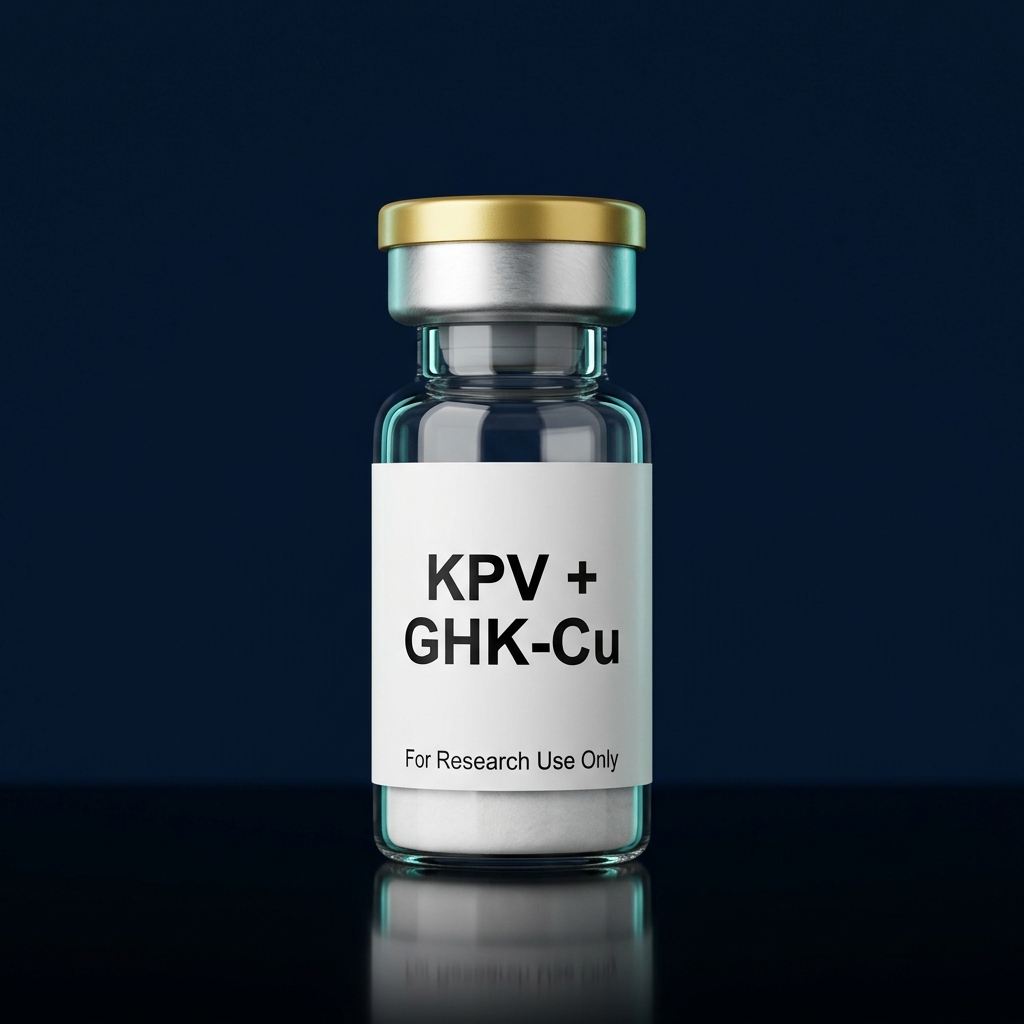
GHK-Cu + KPV Blend is a 60mg dual-peptide research formulation containing 50mg of GHK-Cu and 10mg of KPV. The two compounds are supplied together as a co-lyophilized powder in a single sealed glass vial for controlled in-vitro and laboratory investigation.
GHK-Cu is the copper complex of the naturally occurring tripeptide Gly-His-Lys. Experimental research has investigated this copper-binding peptide in fibroblast biology, extracellular-matrix remodeling, collagen-associated processes, antioxidant pathways, and cellular signaling.
KPV + GHK-Cu Blend
KPV is the tripeptide Lys-Pro-Val, corresponding to the C-terminal sequence of alpha-melanocyte-stimulating hormone (alpha-MSH). It has been studied in epithelial and inflammatory signaling models, including experimental work involving melanocortin receptors and NF-kB-associated pathways.
KPV + GHK-Cu Blend
Combining these two research materials allows investigators to examine matrix-associated and epithelial signaling processes within the same experimental system.
GHK-Cu Research Overview
GHK-Cu has a long history as a research compound in connective-tissue and cellular models. GHK itself is a naturally occurring tripeptide identified in biological fluids including plasma, saliva, and urine. Coordination with copper produces a complex with biological properties that differ from those of the uncomplexed peptide.
Cell and preclinical research has investigated the copper complex in relation to fibroblast activity, extracellular-matrix organization, collagen-associated pathways, glycosaminoglycan production, oxidative signaling, and gene-expression responses.
These findings make the compound relevant to controlled matrix-remodeling research. They should not, however, be interpreted as demonstrating cosmetic, regenerative, anti-aging, or therapeutic effects in humans.
KPV + GHK-Cu Blend
Researchers interested specifically in this component can review the Certa Peptides GHK-Cu research peptide. The originally supplied GHK-Cu product reference provides additional related product context.
KPV and Epithelial Signaling Research
KPV provides a mechanistically distinct component. The Lys-Pro-Val sequence is derived from the C-terminal region of alpha-MSH and has been investigated in experimental inflammatory models.
Research has examined interactions involving melanocortin signaling and intracellular pathways such as NF-kB. Epithelial models have also been used to investigate downstream inflammatory mediators and cellular responses under experimentally induced inflammatory conditions.
KPV + GHK-Cu Blend
The rationale for combining KPV with a copper tripeptide is experimental rather than therapeutic. Researchers can examine both compounds simultaneously and compare responses with suitable individual-peptide controls.
KPV + GHK-Cu Blend
The originally supplied KPV research product provides component-specific context for the Lys-Pro-Val tripeptide.
Because the formulation contains two distinct compounds, observed responses cannot automatically be attributed to either component individually. Appropriate controls are important when investigating mechanism, pathway specificity, or possible interactions between the peptides.
Researchers examining related copper-peptide systems can also review AHK-Cu 100mg, a distinct copper-containing tripeptide research material. AHK-Cu should not be considered interchangeable with GHK-Cu because the peptide sequences and associated experimental literature differ.
For a mechanistically different area of peptide research, Certa Peptides also provides MOTS-c. This material is linked as a separate research compound and is not presented as functionally equivalent to either component of this blend.
General chemical and biochemical reference information may be explored through PubChem. External scientific databases provide reference information only and do not independently verify the composition, identity, purity, or analytical quality of a specific Certa Peptides product.
Quality & Testing
Certa Peptides supplies the formulation as 60mg total co-lyophilized research material consisting of 50mg GHK-Cu and 10mg KPV in a single sealed glass vial.
No specific purity percentage, independent analytical testing result, molecular weight, sterility claim, or manufacturing certification has been supplied for this particular blended product. These characteristics should therefore not be assumed from specifications associated with either individual component.
Researchers should consult available batch-specific documentation when evaluating the formulation for a particular experimental protocol.
The two-component format also requires appropriate experimental controls. Studies intended to distinguish copper-peptide-associated responses from KPV-associated signaling should consider comparison with the individual compounds where appropriate.
Storage & Handling
No product-specific storage conditions were supplied for this 60mg co-lyophilized formulation. Researchers should therefore follow the product label, available batch documentation, validated laboratory procedures, and institutional requirements for storage and handling.
Storage specifications from an individual peptide should not automatically be applied to a co-lyophilized formulation unless confirmed by the relevant product documentation.
No human reconstitution, dosage, injection, administration, topical application, cosmetic-use, or treatment instructions are provided.
Frequently Asked Questions
What is GHK-Cu?
GHK-Cu is the copper complex of Gly-His-Lys, a naturally occurring tripeptide. Laboratory research has investigated it in fibroblast, extracellular-matrix, collagen-associated, antioxidant, and gene-expression models.
What is KPV?
KPV is Lys-Pro-Val, the C-terminal tripeptide sequence of alpha-MSH. It has been investigated in melanocortin, epithelial, NF-kB, and inflammatory signaling models.
Why are GHK-Cu and KPV combined?
The compounds have distinct research profiles. The copper tripeptide is commonly investigated in matrix and fibroblast biology, while KPV is studied in epithelial and inflammatory signaling. Combining them allows researchers to investigate both within a single controlled experimental system.
What does the 60mg blend contain?
Each vial contains 50mg of GHK-Cu and 10mg of KPV, providing 60mg total research material. The components are supplied together as a co-lyophilized powder in one sealed glass vial.
How should combination-study results be interpreted?
Because both compounds are present simultaneously, an observed response cannot automatically be assigned to one component. Individual-compound controls and other appropriate comparison groups can help researchers distinguish component-specific responses from effects associated with the combination.
Is this blend intended for human or cosmetic use?
No. Certa Peptides supplies this formulation strictly for in-vitro and laboratory research. It is not intended for human or veterinary use, consumption, ingestion, injection, topical application, cosmetic use, diagnosis, or therapeutic purposes.
Research Use Disclaimer
Research described on this page concerns laboratory and preclinical models. Findings involving fibroblasts, extracellular-matrix biology, collagen-associated pathways, epithelial cells, melanocortin signaling, NF-kB, or inflammatory pathways should not be interpreted as established cosmetic, regenerative, anti-aging, or therapeutic outcomes in humans.
For laboratory research use only. Not for human or veterinary use. Not intended for consumption or for diagnosing, treating, curing, or preventing any disease.
Laboratory Research Use Only.
| Quantity | Discount | Price |
|---|---|---|
| 3, 4 | 5% off | 66.49 € |
| 5, 9 | 10% off | 62.99 € |
| 10+ Best value | 15% off | 59.49 € |
KPV + GHK-Cu Blend 60mg – Copper Peptide Research Blend
Introduction to KPV + GHK-Cu Blend
KPV + GHK-Cu Blend is a 60mg dual-peptide research formulation containing 50mg of GHK-Cu and 10mg of KPV. The two compounds are supplied together as a co-lyophilized powder in a single sealed glass vial for controlled in-vitro and laboratory investigation.
KPV + GHK-Cu Blend
GHK-Cu is the copper complex of the naturally occurring tripeptide Gly-His-Lys. Experimental research has investigated this copper-binding peptide in fibroblast biology, extracellular-matrix remodeling, collagen-associated processes, antioxidant pathways, and cellular signaling.
KPV is the tripeptide Lys-Pro-Val, corresponding to the C-terminal sequence of alpha-melanocyte-stimulating hormone (alpha-MSH). It has been studied in epithelial and inflammatory signaling models, including experimental work involving melanocortin receptors and NF-kB-associated pathways.
KPV + GHK-Cu Blend
KPV + GHK-Cu Blend
Combining these two research materials allows investigators to examine matrix-associated and epithelial signaling processes within the same experimental system.
GHK-Cu Research Overview
GHK-Cu has a long history as a research compound in connective-tissue and cellular models. GHK itself is a naturally occurring tripeptide identified in biological fluids including plasma, saliva, and urine. Coordination with copper produces a complex with biological properties that differ from those of the uncomplexed peptide.
KPV + GHK-Cu Blend
Cell and preclinical research has investigated the copper complex in relation to fibroblast activity, extracellular-matrix organization, collagen-associated pathways, glycosaminoglycan production, oxidative signaling, and gene-expression responses.
These findings make the compound relevant to controlled matrix-remodeling research. They should not, however, be interpreted as demonstrating cosmetic, regenerative, anti-aging, or therapeutic effects in humans.
Researchers interested specifically in this component can review the Certa Peptides GHK-Cu research peptide. The originally supplied GHK-Cu product reference provides additional related product context.
KPV and Epithelial Signaling Research
KPV provides a mechanistically distinct component. The Lys-Pro-Val sequence is derived from the C-terminal region of alpha-MSH and has been investigated in experimental inflammatory models.
Research has examined interactions involving melanocortin signaling and intracellular pathways such as NF-kB. Epithelial models have also been used to investigate downstream inflammatory mediators and cellular responses under experimentally induced inflammatory conditions.
The rationale for combining KPV with a copper tripeptide is experimental rather than therapeutic. Researchers can examine both compounds simultaneously and compare responses with suitable individual-peptide controls.
The originally supplied KPV research product provides component-specific context for the Lys-Pro-Val tripeptide.
Because the formulation contains two distinct compounds, observed responses cannot automatically be attributed to either component individually. Appropriate controls are important when investigating mechanism, pathway specificity, or possible interactions between the peptides.
Researchers examining related copper-peptide systems can also review AHK-Cu 100mg, a distinct copper-containing tripeptide research material. AHK-Cu should not be considered interchangeable with GHK-Cu because the peptide sequences and associated experimental literature differ.
For a mechanistically different area of peptide research, Certa Peptides also provides MOTS-c. This material is linked as a separate research compound and is not presented as functionally equivalent to either component of this blend. KPV + GHK-Cu
General chemical and biochemical reference information may be explored through PubChem. External scientific databases provide reference information only and do not independently verify the composition, identity, purity, or analytical quality of a specific Certa Peptides product.
Quality & Testing
Certa Peptides supplies the formulation as 60mg total co-lyophilized research material consisting of 50mg GHK-Cu and 10mg KPV in a single sealed glass vial. KPV + GHK-Cu
No specific purity percentage, independent analytical testing result, molecular weight, sterility claim, or manufacturing certification has been supplied for this particular blended product. These characteristics should therefore not be assumed from specifications associated with either individual component.
KPV + GHK-Cu Blend
Researchers should consult available batch-specific documentation when evaluating the formulation for a particular experimental protocol.
The two-component format also requires appropriate experimental controls. Studies intended to distinguish copper-peptide-associated responses from KPV-associated signaling should consider comparison with the individual compounds where appropriate.
Storage & Handling
No product-specific storage conditions were supplied for this 60mg co-lyophilized formulation. Researchers should therefore follow the product label, available batch documentation, validated laboratory procedures, and institutional requirements for storage and handling. KPV + GHK-Cu
Storage specifications from an individual peptide should not automatically be applied to a co-lyophilized formulation unless confirmed by the relevant product documentation.
KPV + GHK-Cu Blend
No human reconstitution, dosage, injection, administration, topical application, cosmetic-use, or treatment instructions are provided.
Frequently Asked Questions
What is GHK-Cu?
GHK-Cu is the copper complex of Gly-His-Lys, a naturally occurring tripeptide. Laboratory research has investigated it in fibroblast, extracellular-matrix, collagen-associated, antioxidant, and gene-expression models.
What is KPV?
KPV is Lys-Pro-Val, the C-terminal tripeptide sequence of alpha-MSH. It has been investigated in melanocortin, epithelial, NF-kB, and inflammatory signaling models.
Why are GHK-Cu and KPV combined?
The compounds have distinct research profiles. The copper tripeptide is commonly investigated in matrix and fibroblast biology, while KPV is studied in epithelial and inflammatory signaling. Combining them allows researchers to investigate both within a single controlled experimental system.
KPV + GHK-Cu Blend
What does the 60mg blend contain?
Each vial contains 50mg of GHK-Cu and 10mg of KPV, providing 60mg total research material. The components are supplied together as a co-lyophilized powder in one sealed glass vial.
How should combination-study results be interpreted?
Because both compounds are present simultaneously, an observed response cannot automatically be assigned to one component. Individual-compound controls and other appropriate comparison groups can help researchers distinguish component-specific responses from effects associated with the combination.
Is this blend intended for human or cosmetic use?
No. Certa Peptides supplies this formulation strictly for in-vitro and laboratory research. It is not intended for human or veterinary use, consumption, ingestion, injection, topical application, cosmetic use, diagnosis, or therapeutic purposes.
KPV + GHK-Cu Blend
Research Use Disclaimer
Research described on this page concerns laboratory and preclinical models. Findings involving fibroblasts, extracellular-matrix biology, collagen-associated pathways, epithelial cells, melanocortin signaling, NF-kB, or inflammatory pathways should not be interpreted as established cosmetic, regenerative, anti-aging, or therapeutic outcomes in humans.
For laboratory research use only. Not for human or veterinary use. Not intended for consumption or for diagnosing, treating, curing, or preventing any disease.
Laboratory Research Use Only.
You must be logged in to post a review.
Reviews
There are no reviews yet.