
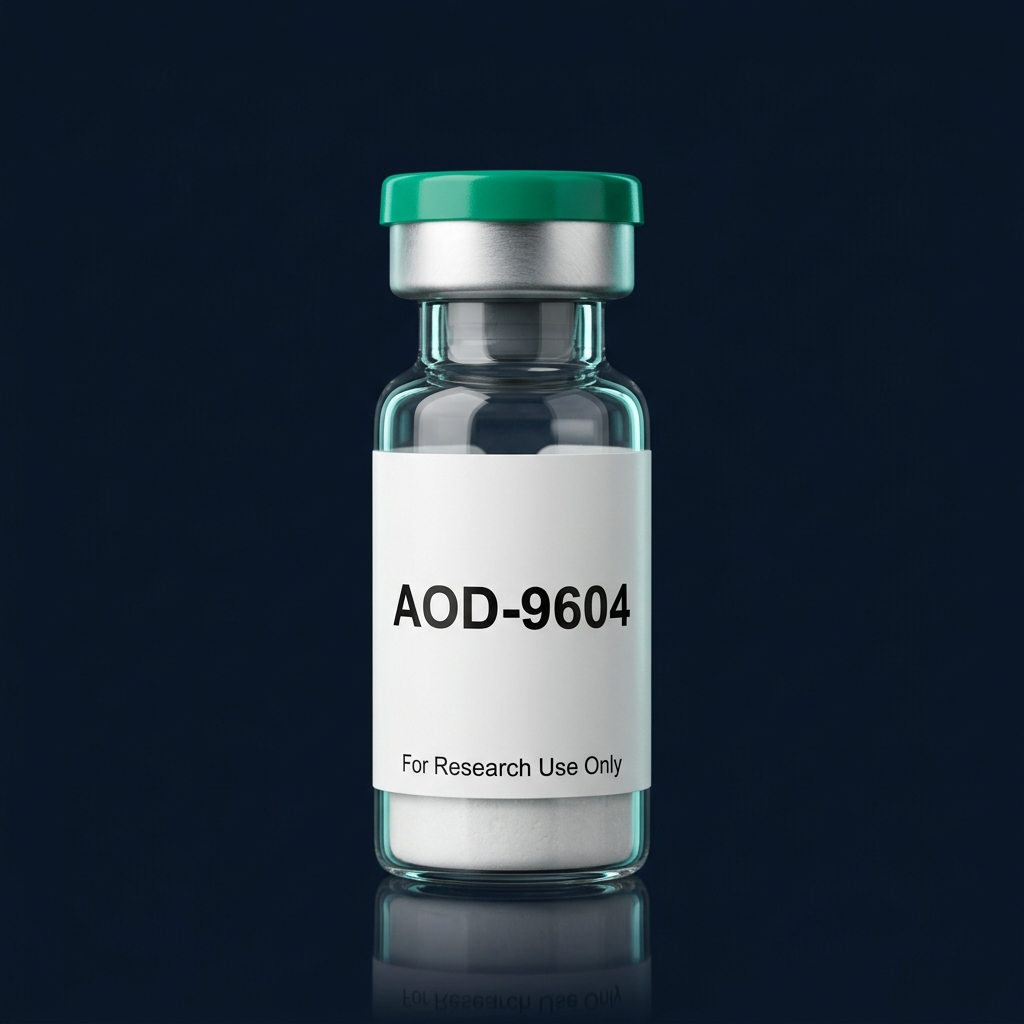
AOD-9604
Price range: 29.99 € through 119.99 €
AOD 9604 peptide is a synthetic, modified fragment derived from the C-terminal region of human growth hormone and studied in lipid-metabolism, adipose-tissue, and cartilage research. Supplied as lyophilized material to a ≥98% supplier batch purity specification, with selected lots independently tested. For laboratory research use only.
| Quantity | Discount | Price |
|---|---|---|
| 3, 4 | 5% off | 28.49 € |
| 5, 9 | 10% off | 26.99 € |
| 10+ Best value | 15% off | 25.49 € |
AOD 9604 Peptide – HGH Fragment Research Compound
Introduction to AOD 9604 Peptide
AOD 9604 peptide is a synthetic modified fragment derived from the C-terminal region of human growth hormone (HGH). It was developed from research examining whether specific biological activities associated with the much larger growth hormone molecule could be investigated using a smaller peptide fragment without reproducing the complete hormone’s signaling profile.
AOD-9604 is based on the HGH 177–191 region with an additional N-terminal tyrosine modification. This structural relationship makes it relevant to research comparing full-length growth hormone, native HGH fragments, and modified peptide analogues.
The supplied specifications identify CAS 221231-10-3, molecular weight approximately 1,815.1 Da, and SKU CP-AOD. Certa Peptides supplies the compound as lyophilized powder to a ≥98% supplier batch purity specification.
AOD 9604 Peptide Research Overview
A major area of experimental interest concerns adipose-tissue and lipid-metabolism signaling. Research has investigated whether biological activity associated with the C-terminal region of growth hormone can be separated from the classical growth-promoting effects of the intact hormone.
Experimental literature has examined endpoints involving lipolytic and lipogenic pathways, fatty-acid metabolism, and adipose-tissue signaling. Beta-adrenergic pathways have also been discussed in mechanistic research concerning the fragment.
This selectivity is scientifically relevant because it allows researchers to investigate a limited region of a larger hormone and compare its activity with that of the intact parent molecule.
However, observations in experimental metabolic models do not establish fat-loss, weight-management, body-composition, or performance benefits in humans.
Relationship to Human Growth Hormone
Full-length human growth hormone acts through the growth hormone receptor and produces a broad range of downstream effects, including signaling associated with IGF-1.
AOD-9604 was developed to investigate biological activity associated with a much smaller HGH-derived sequence. Research has reported a signaling profile distinct from full-length growth hormone, including an absence of classical growth-promoting activity in studied systems.
Claims that the fragment universally has “no effect” on IGF-1, glucose regulation, or other GH-associated pathways should nevertheless be interpreted within the specific experimental conditions in which those endpoints were measured. Absence of an observed effect in a study does not establish that an effect is impossible in every model or concentration.
AOD-9604 vs HGH Fragment 176-191
AOD-9604 and HGH Fragment 176-191 are closely related but should not be treated as identical research materials.
HGH Fragment 176-191 corresponds to a C-terminal region of growth hormone, while AOD-9604 is a modified analogue based on the 177–191 region with an additional N-terminal tyrosine. Structural modification can affect stability, pharmacological behavior, and experimental interpretation.
Comparative research can therefore examine whether modifying a naturally occurring hormone fragment alters its biological properties while retaining selected signaling characteristics.
Researchers can review the current Certa Peptides AOD-9604 research product and the originally supplied AOD-9604 reference for product-specific context.
Cartilage and Chondrocyte Research
In addition to metabolic research, AOD-9604 has been investigated in experimental cartilage models. Reported work has examined chondrocyte-associated endpoints and cartilage biology, providing a research direction distinct from the compound’s better-known metabolic studies.
These findings should be described as experimental observations rather than evidence of cartilage repair or osteoarthritis treatment. The relevance of cell-based or animal-model findings to human outcomes cannot be assumed.
Researchers interested in a mechanistically different peptide associated with aging and cellular research can also review Epitalon. Epitalon is structurally and mechanistically distinct and is provided only as a related research-catalog reference.
General chemical reference information may also be explored through PubChem. External scientific databases provide general compound information and do not independently verify the identity, purity, or analytical quality of a specific Certa Peptides batch.
Quality & Testing
Certa Peptides supplies AOD-9604 as lyophilized research material to a documented ≥98% supplier batch purity specification.
Selected lots are independently analyzed by Janoshik Analytical. Where available, analytical documentation can be searched by batch code through the supplied Certa Peptides batch verification resource.
Independent analysis of selected lots should not be interpreted as confirmation that every production lot has identical analytical results. Researchers should consult the documentation corresponding to the specific batch used in an experiment.
The supplied specifications identify molecular weight as approximately 1,815.1 Da, CAS 221231-10-3, and SKU CP-AOD.
Storage & Handling
No product-specific storage temperature or post-reconstitution stability period was supplied in the provided documentation. Researchers should therefore follow the product label, available batch documentation, validated laboratory procedures, and applicable institutional requirements.
As with peptide research materials generally, experimental handling should account for factors such as temperature, light exposure, moisture, solution conditions, and repeated handling where relevant to the validated protocol.
No human reconstitution, oral-use protocol, dosage, injection, administration, weight-management, body-composition, performance, or treatment instructions are provided.
Frequently Asked Questions
What is AOD 9604 peptide?
AOD-9604 is a synthetic modified peptide derived from the C-terminal region of human growth hormone. It is based on the HGH 177–191 region with an N-terminal tyrosine modification and is investigated primarily in metabolic and related experimental models.
Is AOD-9604 the same as full-length human growth hormone?
No. Full-length HGH is a substantially larger hormone with broad growth hormone receptor-mediated biological activity. AOD-9604 is a small modified fragment designed for research into selected biological signaling associated with the C-terminal region.
Does AOD-9604 activate the growth hormone receptor?
Research characterizing the compound has distinguished its activity from the classical growth-promoting signaling of full-length HGH. Researchers should evaluate receptor and pathway activity within the specific model being studied rather than assuming that every biological endpoint has been completely excluded.
How does AOD-9604 differ from HGH Fragment 176-191?
The compounds are closely related but structurally distinct. HGH Fragment 176-191 represents a native C-terminal HGH sequence, whereas AOD-9604 is based on residues 177–191 with an additional N-terminal tyrosine modification.
Why is AOD-9604 studied in cartilage research?
Experimental studies have reported effects on chondrocyte- and cartilage-associated endpoints. This has created a secondary research area beyond lipid-metabolism studies, but such findings do not establish cartilage-repair or osteoarthritis treatment effects in humans.
Is AOD-9604 intended for human use?
No. Certa Peptides supplies this compound strictly for laboratory research. References to adipose tissue, lipid metabolism, body-composition endpoints, chondrocytes, or cartilage describe scientific research contexts and are not weight-loss, performance, medical, or therapeutic claims.
Research Use Disclaimer
Research described on this page concerns laboratory and preclinical models. Findings involving adipose-tissue signaling, lipid metabolism, fatty-acid pathways, growth hormone fragments, chondrocytes, cartilage, or body-composition endpoints should not be interpreted as established weight-loss, fat-loss, metabolic, anti-aging, cartilage-repair, performance, or therapeutic outcomes in humans.
For laboratory research use only. Not for human or veterinary use. Not intended for consumption or for diagnosing, treating, curing, or preventing any disease.
Laboratory Research Use Only.
| Size |
2mg ,5mg ,10mg |
|---|
You must be logged in to post a review.
Reviews
There are no reviews yet.