
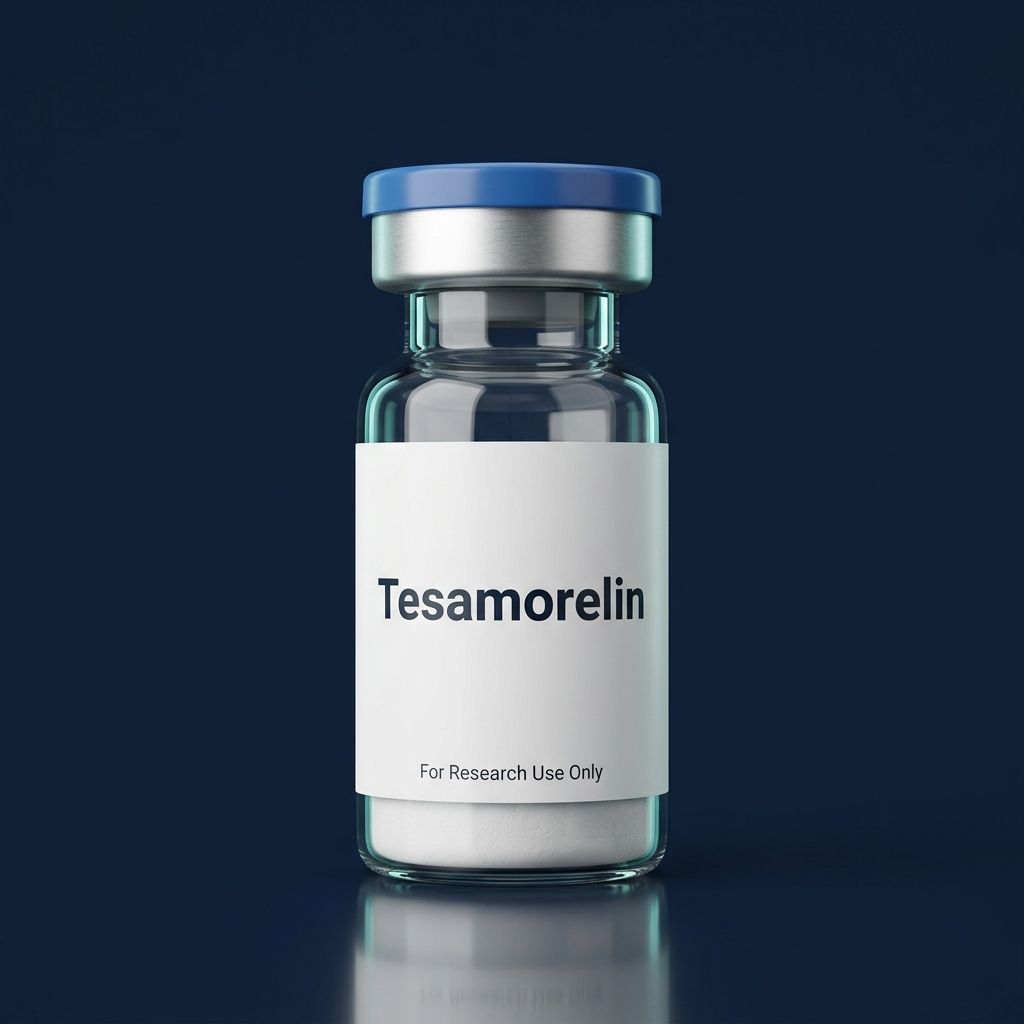
Tesamorelin
Price range: 22.99 € through 147.99 €
Tesamorelin peptide is a synthetic 44-amino-acid GHRH analogue with an N-terminal trans-3-hexenoic acid modification, studied in pituitary GHRH-receptor, GH/IGF-1, and metabolic research. Supplied as lyophilized material to a ≥98% supplier batch specification, with selected lots independently tested. For laboratory research use only.
| Quantity | Discount | Price |
|---|---|---|
| 3, 4 | 5% off | 21.84 € |
| 5, 9 | 10% off | 20.69 € |
| 10+ Best value | 15% off | 19.54 € |
Tesamorelin Peptide – Full-Length GHRH Research Analogue
Introduction to Tesamorelin Peptide
Tesamorelin peptide is a synthetic analogue of human growth-hormone-releasing hormone, based on the full 44-amino-acid GHRH sequence with an N-terminal trans-3-hexenoic acid modification. This structural modification is associated with increased resistance to enzymatic degradation relative to unmodified GHRH.
The compound is widely characterized in GHRH-receptor, growth hormone, IGF-1, adipose-tissue, and metabolic research. Its relatively extensive published research dataset also makes it useful as a reference compound when comparing full-length modified GHRH analogues with shorter sequences.
The supplied specifications identify CAS 218949-48-5 and molecular weight approximately 5,135.9 Da. Certa Peptides supplies the compound as a research reagent and reseller rather than its manufacturer or formulator. The material is provided as lyophilized powder to a ≥98% supplier batch specification.
Tesamorelin Peptide Research Overview
Growth-hormone-releasing hormone is a hypothalamic signaling peptide involved in regulation of pituitary somatotroph activity. GHRH receptor activation is associated with Gs-protein signaling, adenylyl cyclase activity, increased intracellular cAMP, and downstream processes involved in pulsatile GH secretion.
Research involving tesamorelin has consequently examined both proximal endocrine endpoints and downstream metabolic measurements.
These include GH and IGF-1-associated signaling as well as body-composition and metabolic endpoints measured under controlled research conditions. The existence of these data does not mean that a laboratory research product is intended to reproduce clinical outcomes.
Full-Length GHRH Analogue Research
Tesamorelin retains the 44-residue GHRH sequence while incorporating an N-terminal modification associated with improved stability.
This distinguishes it structurally from shorter GHRH-derived compounds such as sermorelin, which is based on GHRH(1–29). Researchers can review the originally supplied Sermorelin research reference for comparison.
The originally supplied CJC-1295 research reference provides another structurally distinct GHRH-associated compound for comparative research.
These peptides should not be treated as interchangeable. Sequence length, chemical modification, pharmacokinetic behavior, and experimental design can all influence observed results.
The originally supplied Tesamorelin reference provides additional product context.
Visceral Adipose and Metabolic Research
Tesamorelin has an unusually developed research dataset involving quantitative metabolic endpoints. Published studies have measured variables including CT-quantified visceral adipose tissue, hepatic fat, lipid-associated biomarkers, GH, and IGF-1.
This makes the compound relevant as a reference material for experimental questions involving GHRH signaling and downstream metabolic physiology.
Importantly, findings involving visceral adipose tissue or hepatic fat should not be converted into generalized claims about weight loss, fat loss, bodybuilding, or body-composition enhancement. Outcomes observed in defined clinical-research populations cannot automatically be extrapolated to other populations, experimental systems, or research materials.
GHRH-R and GH/IGF-1 Signaling
The GHRH receptor is a class B G-protein-coupled receptor expressed prominently on pituitary somatotrophs. Activation promotes intracellular cAMP signaling associated with regulated GH secretion.
Downstream GH signaling can influence IGF-1 and multiple metabolic pathways. These endocrine relationships provide researchers with measurable endpoints for characterizing GHRH analogues.
Researchers examining dual GHRH-R and GHS-R1a signaling can also review the Certa Peptides CJC-1295 + Ipamorelin Blend as a mechanistically distinct research formulation.
Comparison With Other Endocrine Research Materials
The current Certa Peptides Tesamorelin research product provides the product-specific reference for this material.
Certa Peptides also provides hCG for research involving a different endocrine receptor system. hCG acts through LHCGR rather than GHRH-R and should not be considered an alternative form of a GHRH analogue.
General compound and biochemical information may also be explored through PubChem. External databases provide general scientific information and do not independently verify the identity, purity, composition, or analytical quality of a specific Certa Peptides batch.
Quality & Testing
Certa Peptides supplies this research material as lyophilized powder to a documented ≥98% supplier batch specification. Available sizes in the supplied information are 2mg, 5mg, 10mg, and 20mg.
Selected lots are independently analyzed by Janoshik Analytical using HPLC and mass spectrometry. Where available, analytical reports can be searched by batch code through the supplied Certa Peptides batch verification resource.
Independent analysis applies to selected lots and should not be interpreted as an in-house testing claim or as evidence that every production batch has been independently analyzed. Researchers should consult documentation corresponding to the specific lot used in an experiment.
The supplied specifications identify CAS 218949-48-5 and molecular weight approximately 5,135.9 Da. The salt form is as supplied by the source and should not be inferred beyond available batch documentation.
Storage & Handling
The supplied documentation specifies storage of lyophilized material at −20°C, protected from light.
The provided product information further specifies that, following laboratory reconstitution, the prepared material should be used promptly and should not be refrigerated or frozen. Researchers should follow the product label and batch-specific documentation because handling requirements may depend on formulation.
No human reconstitution procedure, dosage, injection, administration, fat-loss, bodybuilding, hormone-enhancement, or treatment instructions are provided.
Frequently Asked Questions
What is tesamorelin peptide?
Tesamorelin is a synthetic GHRH analogue based on the full 44-amino-acid human GHRH sequence with an N-terminal trans-3-hexenoic acid modification. It is studied in GHRH-receptor and downstream endocrine-signaling research.
How does tesamorelin differ from sermorelin?
Sermorelin is based on GHRH(1–29), whereas tesamorelin retains the full 44-residue sequence and incorporates an N-terminal modification associated with increased stability. These structural differences are relevant to experimental design and pharmacological characterization.
Why is tesamorelin associated with visceral-adipose research?
Published research has used quantitative imaging endpoints, including CT-measured visceral adipose tissue, when characterizing the compound. This created a substantial dataset linking GHRH-associated signaling with metabolic and adipose-tissue research.
What endpoints have been investigated?
Research has measured GH, IGF-1, visceral adipose tissue, hepatic fat, and multiple metabolic or lipid-associated biomarkers. These endpoints are research measurements and should not be interpreted as promises of fat-loss or body-composition outcomes.
What are the documented product specifications?
The supplied material has CAS 218949-48-5, molecular weight approximately 5,135.9 Da, and a ≥98% supplier batch specification. It is supplied as lyophilized powder in 2mg, 5mg, 10mg, and 20mg sizes.
Is tesamorelin intended for human use?
No. Certa Peptides supplies this material strictly for laboratory research. References to GH, IGF-1, visceral adipose tissue, hepatic fat, or metabolic signaling describe scientific research contexts and are not weight-loss, bodybuilding, anti-aging, medical, or therapeutic claims.
Research Use Disclaimer
Research described on this page concerns laboratory, preclinical, and published investigational contexts. Findings involving GHRH-R, growth hormone, IGF-1, visceral adipose tissue, hepatic fat, metabolic biomarkers, or body-composition endpoints should not be interpreted as established weight-loss, fat-loss, bodybuilding, anti-aging, hormonal, metabolic, or therapeutic outcomes in humans.
For laboratory research use only. Not for human or veterinary use. Not intended for consumption or for diagnosing, treating, curing, or preventing any disease.
Laboratory Research Use Only.
| Size |
2mg ,5mg ,10mg ,20mg |
|---|
You must be logged in to post a review.
Related products
CJC-1295 + Ipamorelin Blend
Price range: 68.49 € through 107.99 €
CJC-1295 With DAC
Price range: 42.99 € through 59.99 €
CJC-1295 Without DAC
Price range: 29.99 € through 71.99 €
HCG
Price range: 39.99 € through 99.99 €
Reviews
There are no reviews yet.