
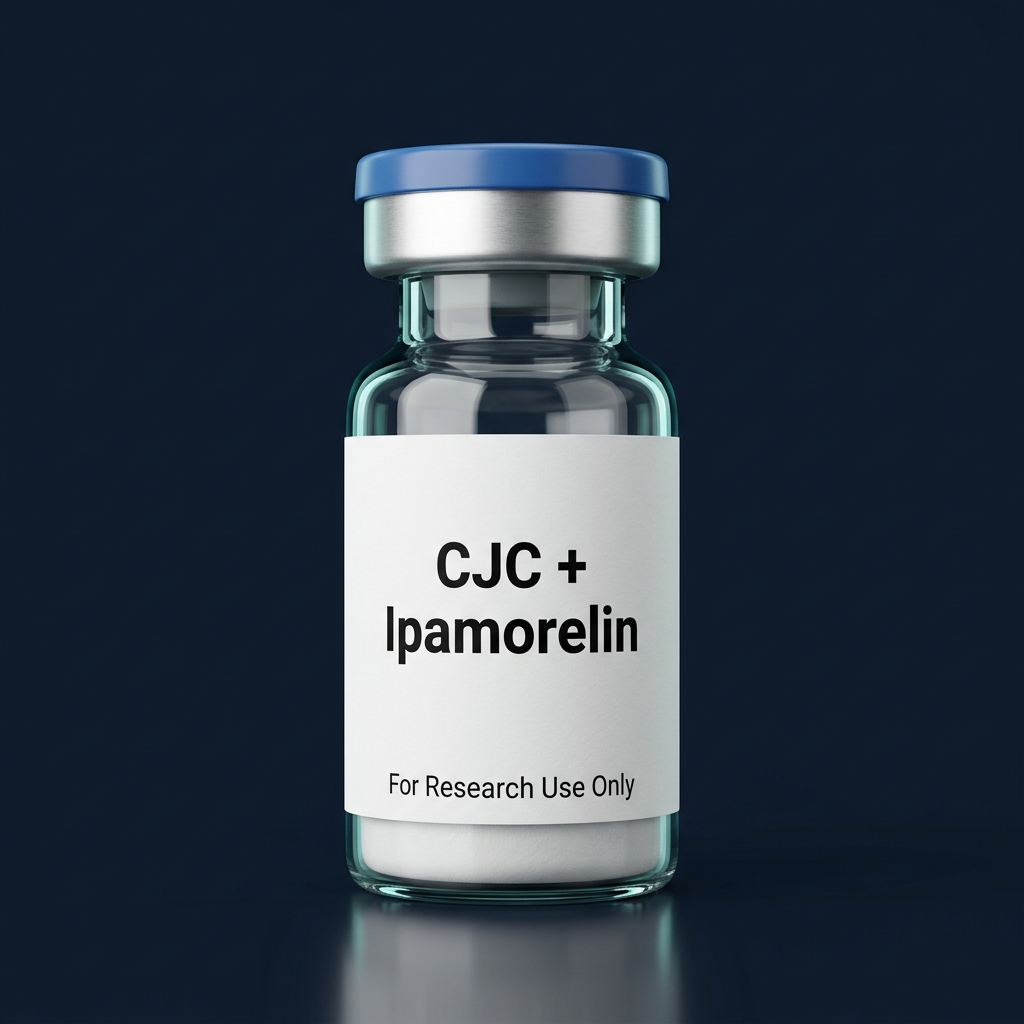
CJC-1295 + Ipamorelin Blend
Price range: 68.49 € through 107.99 €
CJC 1295 Ipamorelin Blend combines CJC-1295 without DAC (Mod GRF 1-29) with ipamorelin in one lyophilized research formulation. The two components target GHRH-R and GHS-R1a respectively, supporting laboratory investigation of dual-receptor pituitary GH signaling. Supplied to a ≥98% supplier batch purity specification for laboratory research only.
| Quantity | Discount | Price |
|---|---|---|
| 3, 4 | 5% off | 65.07 € |
| 5, 9 | 10% off | 61.64 € |
| 10+ Best value | 15% off | 58.22 € |
CJC 1295 Ipamorelin Blend – Dual-Receptor Research Peptides
Introduction to CJC 1295 Ipamorelin Blend
CJC 1295 Ipamorelin Blend combines two research peptides associated with separate receptor systems involved in pituitary growth hormone signaling: CJC-1295 without DAC, also called Mod GRF 1-29, and ipamorelin.
Mod GRF 1-29 is a growth hormone-releasing hormone analog studied through the GHRH receptor. Ipamorelin is a synthetic growth hormone secretagogue studied as a selective agonist of growth hormone secretagogue receptor 1a (GHS-R1a), also known as the ghrelin receptor.
Because these receptor systems use different intracellular signaling mechanisms, the combination is relevant to experiments investigating convergent regulation of pituitary somatotroph activity. Certa Peptides supplies the formulation as lyophilized material in 10mg and 20mg blend formats to a ≥98% supplier batch purity specification.
CJC 1295 Ipamorelin Blend Research Overview
GHRH-R and GHS-R1a represent distinct receptor systems capable of influencing growth hormone release from pituitary somatotrophs.
GHRH receptor activation is primarily associated with Gs-mediated stimulation of adenylyl cyclase and increased intracellular cAMP. GHS-R1a signaling involves pathways including phospholipase C, protein kinase C, and intracellular calcium mobilization.
Because the pathways are not identical, simultaneous experimental activation can produce responses different from those observed when either receptor system is investigated independently.
This provides a mechanistic basis for dual-receptor studies examining GH-axis dynamics, secretagogue interactions, pulse-associated signaling, and feedback regulation.
Why Combine Mod GRF 1-29 and Ipamorelin?
The research rationale is based on complementary receptor pharmacology rather than two compounds duplicating the same signal.
Mod GRF 1-29 provides the GHRH-receptor component. Ipamorelin provides the GHS-R1a component. Experimental activation of these separate pathways can converge on pituitary GH secretion.
The originally supplied CJC-1295 research reference provides related information about the GHRH-analog family, while the originally supplied ipamorelin research reference provides additional GHS-R1a context.
Researchers should note that this formulation contains CJC-1295 without DAC. It should therefore not be assumed to have the same pharmacokinetic characteristics as DAC-conjugated CJC-1295.
Ipamorelin Selectivity in GHS-R1a Research
Ipamorelin has been investigated as a comparatively selective growth hormone secretagogue. Experimental studies have measured GH responses alongside ACTH, cortisol, and prolactin to characterize this selectivity.
This makes the compound relevant to experiments in which researchers want to investigate GHS-R1a-associated signaling while reducing additional endocrine variables observed with some earlier GHRP compounds.
However, “selective” does not mean completely specific under every experimental condition. Receptor expression, concentration, model selection, and assay design remain important.
Researchers can review the current Certa Peptides Ipamorelin research product for individual-component information.
Dual-Receptor and Feedback Research
The GH axis incorporates multiple regulatory signals, including hypothalamic GHRH and somatostatin pathways. Secretagogue experiments can therefore examine not only response magnitude but also feedback architecture and temporal signaling.
Dual-pathway stimulation has been investigated in relation to GH pulse characteristics and receptor-level interactions. Claims that a combination universally produces a specific degree of synergy should be avoided because experimental outcomes depend on model, concentration, timing, receptor expression, and other conditions.
Likewise, statements regarding preservation of somatostatin sensitivity should be interpreted as research hypotheses or model-dependent observations rather than guaranteed characteristics of every experimental system.
The current Certa Peptides CJC-1295 + Ipamorelin research blend provides the product-specific reference.
Comparison With Tesamorelin Research
Tesamorelin is another peptide associated with GHRH-receptor research, but it is structurally distinct from Mod GRF 1-29 and should not be treated as an interchangeable material.
Researchers comparing different GHRH-related compounds can review Tesamorelin as a separate research reference.
Experiments intended to isolate receptor-specific effects should generally include appropriate individual-component and vehicle controls rather than relying solely on a premixed formulation.
General compound and biochemical reference information can also be explored through PubChem. External databases provide general scientific information and do not independently verify the composition, identity, purity, or analytical quality of a specific Certa Peptides batch.
Quality & Testing
The formulation contains CJC-1295 without DAC (Mod GRF 1-29) and ipamorelin and is supplied in 10mg and 20mg blend formats.
The supplied documentation specifies ≥98% supplier batch purity. Selected lots are independently analyzed by Janoshik Analytical and can be searched by batch code through the supplied Certa Peptides batch verification resource.
Independent testing of selected lots should not be interpreted as confirmation that every vial or production batch has identical analytical characteristics. Researchers should consult documentation associated with the specific batch used in an experiment.
The supplied documentation also states that the product is sold and shipped from the EU by CERTALAB S.R.L.
Storage & Handling
The supplied documentation specifies storage of lyophilized material at -20°C away from light. Following laboratory reconstitution, the documented storage range is 2–8°C.
Researchers should follow the product label, available batch documentation, validated laboratory procedures, and applicable institutional requirements. No post-reconstitution use period was supplied, so one should not be inferred.
No human reconstitution, concentration calculation, dosage, injection, administration, hormone-enhancement, body-composition, performance, anti-aging, or treatment instructions are provided.
Frequently Asked Questions
What is the CJC 1295 Ipamorelin Blend?
It is a laboratory research formulation combining CJC-1295 without DAC (Mod GRF 1-29) with ipamorelin. The components are studied through GHRH-R and GHS-R1a respectively.
Why are CJC-1295 without DAC and ipamorelin combined?
The compounds target separate receptor systems with different intracellular signaling pathways. This makes the combination useful for experiments investigating convergent regulation of pituitary GH-associated signaling.
Is the CJC-1295 component the DAC version?
No. The supplied specifications identify the component as CJC-1295 without DAC, also known as Mod GRF 1-29. DAC-conjugated CJC-1295 has different structural and pharmacokinetic characteristics.
Why is ipamorelin used instead of another GHRP?
Ipamorelin has been investigated for comparatively selective GHS-R1a-associated GH signaling with relatively limited ACTH, cortisol, and prolactin responses in reported experimental conditions. These observations remain model- and condition-dependent.
What are the documented product specifications?
The product combines CJC-1295 without DAC and ipamorelin in a lyophilized formulation. Supplied sizes are 10mg and 20mg blends, with a documented ≥98% supplier batch purity specification. Selected lots undergo independent analytical testing.
Is this peptide blend intended for human use?
No. Certa Peptides supplies the formulation strictly for laboratory research. References to growth hormone, pituitary signaling, secretagogue activity, pulse dynamics, or endocrine pathways describe experimental research endpoints and are not medical, anti-aging, performance, or body-composition claims.
Research Use Disclaimer
Research described on this page concerns laboratory and preclinical models. Findings involving GHRH-R, GHS-R1a, cAMP, calcium signaling, protein kinase C, pituitary somatotrophs, growth hormone release, pulse dynamics, or endocrine feedback should not be interpreted as established hormonal, anti-aging, body-composition, performance, or therapeutic outcomes in humans.
For laboratory research use only. Not for human or veterinary use. Not intended for consumption or for diagnosing, treating, curing, or preventing any disease.
Laboratory Research Use Only.
| Size |
10mg ,20mg |
|---|
You must be logged in to post a review.
Related products
CJC-1295 With DAC
Price range: 42.99 € through 59.99 €
CJC-1295 Without DAC
Price range: 29.99 € through 71.99 €
HCG
Price range: 39.99 € through 99.99 €
Ipamorelin
Price range: 23.99 € through 65.99 €
Reviews
There are no reviews yet.