
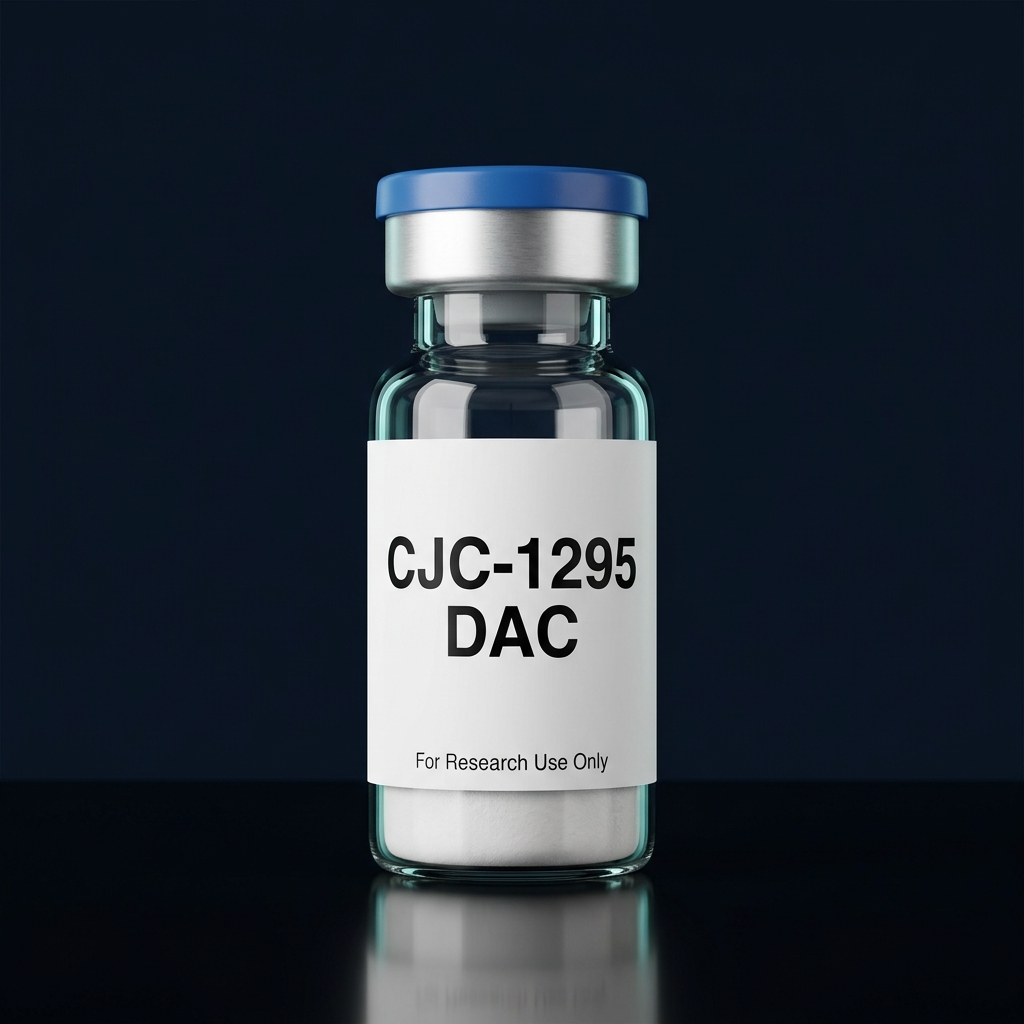
CJC-1295 With DAC
Price range: 42.99 € through 59.99 €
CJC 1295 With DAC is a synthetic GHRH analogue used in laboratory research on growth hormone secretion, GHRH-receptor signaling, and pituitary regulation. The DAC modification is designed to extend biological persistence compared with non-DAC analogues. Supplied as lyophilized powder to a ≥98% supplier batch specification for laboratory research only.
| Quantity | Discount | Price |
|---|---|---|
| 3, 4 | 5% off | 40.84 € |
| 5, 9 | 10% off | 38.69 € |
| 10+ Best value | 15% off | 36.54 € |
CJC 1295 With DAC – GHRH Research Peptide
Introduction to CJC 1295 With DAC
CJC 1295 With DAC is a synthetic growth hormone-releasing hormone (GHRH) analogue used in laboratory research involving pituitary signaling and regulation of growth hormone secretion. The compound incorporates a Drug Affinity Complex (DAC), a modification developed to increase biological persistence relative to shorter-acting GHRH analogues.
GHRH-associated compounds are studied primarily through the GHRH receptor expressed on pituitary somatotrophs. Activation of this receptor is associated with Gs-protein signaling, adenylyl cyclase activity, intracellular cAMP, and downstream processes involved in regulated growth hormone release.
Certa Peptides supplies this research material as lyophilized powder in a sealed glass vial to a ≥98% supplier batch specification. Selected lots undergo independent analytical testing.
CJC 1295 With DAC Research Overview
The hypothalamic-pituitary growth hormone axis involves coordinated signaling between GHRH, somatostatin, ghrelin-associated pathways, pituitary somatotrophs, and downstream endocrine mediators.
GHRH stimulates its receptor on somatotrophs, activating intracellular signaling that contributes to synthesis and secretion of growth hormone. Synthetic GHRH analogues are useful experimental tools for investigating this pathway under controlled conditions.
The defining feature of the DAC form is its affinity-based modification. The Drug Affinity Complex was designed to interact with circulating albumin, thereby changing the compound’s pharmacokinetic behavior compared with shorter-lived GHRH-related peptides.
This distinction is particularly relevant when designing experiments examining duration of signaling, temporal response patterns, receptor activation, or differences between long- and short-acting GHRH analogues.
With DAC vs Without DAC
The presence or absence of DAC is a fundamental experimental distinction.
The DAC-modified compound is designed for extended persistence through albumin association. CJC-1295 without DAC, commonly associated with Mod GRF 1-29 terminology, is a shorter-acting GHRH analogue and should not be assumed to have the same experimental time course.
Researchers specifically comparing these forms can review the Certa Peptides CJC-1295 Without DAC research material alongside the CJC-1295 With DAC product.
These materials should not be treated as interchangeable simply because both act within GHRH-associated research. Experimental design should account for structural and pharmacokinetic differences.
GHRH-Receptor Signaling
The GHRH receptor belongs to the class B family of G-protein-coupled receptors. Its activation is associated predominantly with Gs signaling, increased adenylyl cyclase activity, and elevated intracellular cAMP.
Downstream events can influence pituitary somatotroph function and regulated GH secretion. Researchers may investigate endpoints such as receptor activation, intracellular signaling, secretory dynamics, feedback mechanisms, or interactions with other endocrine pathways.
These experimental endpoints do not establish anti-aging, muscle-building, fat-loss, recovery, performance, or other personal benefits.
Comparison With GHS-R1a Research
GHRH-receptor signaling is distinct from the ghrelin receptor pathway. Growth hormone secretagogues such as ipamorelin are studied through GHS-R1a, which involves signaling pathways including phospholipase C, protein kinase C, and intracellular calcium mobilization.
This distinction allows researchers to investigate GHRH-R and GHS-R1a signaling independently or comparatively.
For individual GHS-R1a research, Certa Peptides provides Ipamorelin as a separate research material.
Experiments comparing or combining GHRH and ghrelin-receptor pathways require appropriate controls because differences in receptor pharmacology, signaling kinetics, concentration, and experimental models can substantially influence observed responses.
General chemical and biochemical reference information may also be explored through PubChem. External scientific databases provide general reference information and do not independently verify the identity, purity, or analytical quality of a particular Certa Peptides batch.
Quality & Testing
Certa Peptides supplies the compound as lyophilized powder in a sealed glass vial to a documented ≥98% supplier batch specification.
Selected lots are independently analyzed by Janoshik Analytical. Where available, researchers can search analytical documentation by batch code through the supplied Certa Peptides batch verification resource.
Testing of selected lots does not mean that every production lot necessarily has identical analytical results. Researchers should consult documentation corresponding to the specific batch used in an experiment.
No CAS number, molecular weight, peptide sequence, formulation quantity, or other batch-specific analytical values were supplied in the provided product information, so these specifications should not be inferred.
Storage & Handling
The supplied documentation specifies -20°C for long-term storage and 2–8°C for short-term storage. The lyophilized research material should be protected from light and moisture.
No specific post-reconstitution storage duration was supplied. Researchers should therefore follow the product label, available batch documentation, validated laboratory procedures, and applicable institutional requirements rather than assuming a stability period.
No human dosage, dosing frequency, concentration calculation, injection, administration, reconstitution procedure, hormone-enhancement protocol, performance protocol, or personal-use instructions are provided.
Frequently Asked Questions
What is CJC 1295 With DAC?
It is a synthetic GHRH analogue containing a Drug Affinity Complex modification. It is used experimentally to investigate GHRH-receptor signaling, pituitary regulation, and growth hormone-associated research pathways.
What does DAC mean in CJC-1295 research?
DAC stands for Drug Affinity Complex. The modification was designed to promote association with circulating albumin and thereby alter biological persistence compared with shorter-acting GHRH analogues.
What is the difference between CJC-1295 with and without DAC?
The principal distinction is pharmacokinetic design. The DAC modification is associated with extended persistence, while the non-DAC form is shorter acting. This difference can substantially affect experimental design and interpretation.
What receptor does CJC-1295 target?
The compound is studied as an analogue of GHRH and therefore primarily in relation to the GHRH receptor on pituitary somatotrophs. This receptor is associated with cAMP-dependent intracellular signaling.
How does CJC-1295 research differ from ipamorelin research?
CJC-1295 is investigated through GHRH-receptor signaling, whereas ipamorelin is studied as a GHS-R1a agonist. The two receptor systems use distinct intracellular pathways and can therefore be investigated independently or in comparative endocrine-signaling experiments.
Is CJC-1295 With DAC intended for human use?
No. Certa Peptides supplies the compound strictly for laboratory research. References to GHRH receptors, pituitary signaling, growth hormone secretion, albumin association, or pharmacokinetics describe research contexts and are not medical, anti-aging, bodybuilding, performance, or therapeutic claims.
Research Use Disclaimer
Research described on this page concerns laboratory and preclinical models. Findings involving GHRH-R signaling, cAMP, pituitary somatotrophs, growth hormone secretion, albumin association, endocrine feedback, or pharmacokinetic behavior should not be interpreted as established hormonal, anti-aging, body-composition, muscle-building, performance, recovery, or therapeutic outcomes in humans.
For laboratory research use only. Not for human or veterinary use. Not intended for consumption or for diagnosing, treating, curing, or preventing any disease.
Laboratory Research Use Only.
| Size |
2mg ,5mg |
|---|
You must be logged in to post a review.
Related products
CJC-1295 + Ipamorelin Blend
Price range: 68.49 € through 107.99 €
CJC-1295 Without DAC
Price range: 29.99 € through 71.99 €
HCG
Price range: 39.99 € through 99.99 €
Ipamorelin
Price range: 23.99 € through 65.99 €
Reviews
There are no reviews yet.